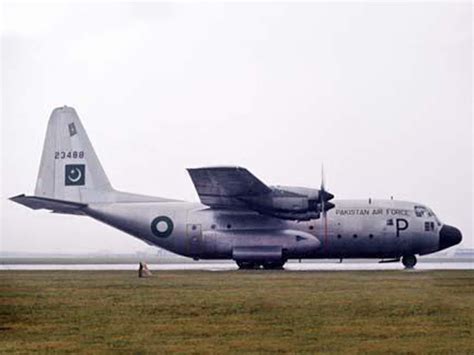
The wars in the Indian sub-continent have been dissected threadbare, but there have been little-known operations done by the American-made C-130s during the 1965 India-Pakistan war. The cargo aircraft supplied to the Pakistan Air Force (PAF) was modified to become a bomber and raid the Indian runways.
The other important mission carried out by the C-130 fleet was the audacious para commando attack planned by Pakistan. The commandos were inserted by C-130B to cripple three frontline airbases of the Indian Air Force (IAF) in Punjab – Pathankot, Halwara (near Ludhiana) and Adampur (near Jalandhar).
The US Air Force (USAF) is now considering the dispersed nature of warfare that it will experience in the Indo-Pacific against China. It is turning its airlifters, C-130J, into traditional bombers and giving them more offensive capabilities. The PAF made the modification in 1965.
On the intervening night of 30-31 August 1965, the general atmosphere in the Indian subcontinent was tense. News of Pakistan’s military build-up along the border hinted at impending war. The IAF ordered its units to arm all its fighter jets and bombers on September 1, 1965.
At 1530 hours, the Number 3 Squadron of the IAF operating the French Dassault Mystere fighter jets was asked to prepare a strike in the Chhamb sector, where the Pakistan Army had intruded into Indian territory.
Twenty-six fighter bombers of the IAF consisting of 12 British-made Vampire aircraft of Number 45 and 220 Squadrons and 14 Mystere aircraft of Number 3 and 31 Squadrons took off from Pathankot for the Chhamb Sector.
“The mission marked the start of the air action against belligerence by Pakistan,” the IAF site reads. Just before 1800 hours, the first IAF aircraft struck the Pakistani Patton Tanks. The IAF managed to annihilate 10 tanks, 2 Anti-Aircraft guns, and 30-40 vehicles of the Pakistani Army.

The newly acquired MiG-21s of the IAF were also providing air cover to the fighters carrying out raids in the next few days. Even on September 6, 1965, the Indian fighter jets carried out strikes in Chhamb (on the Indian side) and Norowal area (on the Pakistani side) with “no enemy air opposition.” “Most of us were highly suspicious of this: the suspense threatened to get us well before PAF did!!!” a tongue-in-cheek entry in the 3 Squadron diary from September 6, 1965 read.
On the same day, PAF’s Sabres entered the Indian airspace and hit the Pathankot airfield. This strike resulted in the destruction of eight IAF aircraft on the ground at Pathankot. The Sabres were heading towards Adampur and Halwara airbase but were stopped by the IAF’s Hawker Hunter fighter jets.
The day also saw the first showdown between the Indian MiG-21s and Pakistani Starfighter 104s. The IAF pilot in MiG-21 fired air-to-air missiles in actual combat.
While the PAF’s Pathankot raid was a success, given the odds in its favor, the failure of the Adampur and Halwara air strikes did not go well with the PAF. Raids on the Amritsar, Porbandar, and Ferozpur radars, as well as Jamnagar airfield, were also a failure. After 6 September, the PAF stopped all daylight bombing missions into India.
Audacious Raids By C-130B
On September 6, the PAF’s raid on Pathankot airbase inflicted large damage. The IAF had also suffered an early setback over Chhamb and had lost four Vampires. This was supposed to have left the IAF in disarray.
Till 6th September, the lack of significant activities on PAF’s side was intriguing the IAF. However, it was just a lull before the PAF put its most audacious plan into action. The Pakistanis dropped paratroopers at Pathankot, Adampur, and Halwara in the intervening night of 6-7 September. Three C-130 aircraft of PAF dropped 60 Special Service Group Commandos each in the wee hours.
The three groups of 60 paratroopers each were dropped in the vicinity of each airbase. Each group was led by one or two officers and a junior commissioned officer (JCO).
The drop was successful, but the Pakistan commandos ran into unforeseen difficulties. A concerted effort by civilians and the Punjab Police resulted in the apprehension of most of the Commandos.
Villagers spotted the Pathankot group first, and an alarm was raised. This led to the discovery of the Halwara group. The Adampur group also landed in the middle of the village, and the dogs’ barking gave away their presence.
In the end, of the 180 para-commandos air-inserted, 138 were taken prisoners and taken to POW camps. Twenty-two were lynched by the joint combing teams of villagers armed with sticks and police. Only 20 para commandos were unaccounted for and were thought to have escaped back to Pakistan.
One notable, commando-style escape was of Major Hazur Hasnain, the Halwara group commander who, along with his friend, hijacked an IAF jeep and somehow managed to return safely.
According to PAF officer Kaiser Tufail’s account, operational considerations for the SSG’s employment were: “The operations would be mounted in the early hours of the night. Air missions (para-commandos) would be dropped on the target. Exfiltration would be either by landing an aircraft on the captured airfield or by rendezvous with a helicopter, given the vast distances separating the targets from friendly forces.”
The Pakistan Army officers were shunted out for opposing the use of the World War II tactic of utilizing “commandos in insurgency and prolonged guerrilla warfare roles that were central to the impending Operation ‘Gibraltar.’”
Four airfields, viz Adampur, Ambala, Pathankot, and Halwara, were agreed upon, though a day before the attack, Ambala was canceled. Three teams, each of 60 commandos including three officers, were planned to be air-dropped by three C-130s. Each team was to have one wireless set to be able to keep the C-130s informed of their progress. Individual commandos were provided with two days’ rations (five methi rotis each) and 400 rupees in Indian currency, in addition to personal weapons, explosives, grenades, etc.
Talking about the ill-planned mission, Tufail opined: “The AHQ (Army Headquarters) had also left several issues unresolved during the planning stage. For instance, the idea of exfiltration of commandos by C-130s landing on the just assaulted airfields defied common sense, but either the PAF C-in-C remained unaware of this plan or had rashly approved it.”
C-130 Bombers Modified
As the war proceeded, the Pakistan Air Force modified the C-130s to drop bombs. C-130 bombers targeted Indian tanks and guns in Ramgarh of the Sialkot sector. As part of its riposte strategy, the Indian Army had made advances in the Sialkot sector in response to Pakistan’s advent in Jammu and Kashmir.
In addition, Indian tanks advanced in the Chawinda region. Both areas resulted in two of the biggest tank battles in the history of the Indian subcontinent.
Two C-130s PAF came out in support of their forces and dropped nine tons of bombs each on the night of 15 September. On the following night, a single C-130 strike was repeated against Ramgarh, destroying Indian tanks and guns as well as ammunition and fuel dumps.
Seven officers of the Transport Wing were awarded the Sitara-e-Jurat, and 2 JCOSs the Tamgha-e-Jurat.
Some estimates suggest that the IAF flew over 4,000 combat sorties and the PAF a little over 2,000. The Indian account of the 1965 war suggested that the IAF lost 36 aircraft while still parked on the ground.
On the other hand, in
aerial dogfights, the IAF lost just 14 aircraft while shooting down 18
Pakistani jet fighters. Pakistan ended the war, having depleted 17
percent of its front-line strength, while India’s losses amounted to
less than 10 percent.


